
Journal · Buyer guide
Huntington Beach vs. Irvine: Beach Town or Master-Planned City?
A grounded, balanced look at how coastal Huntington Beach and inland, master-planned Irvine differ for buyers weighing a move in Orange County.
September 1, 2026 · 12 min read
By Justin Ratowsky, Realtor®, Ratowsky Group at Compass
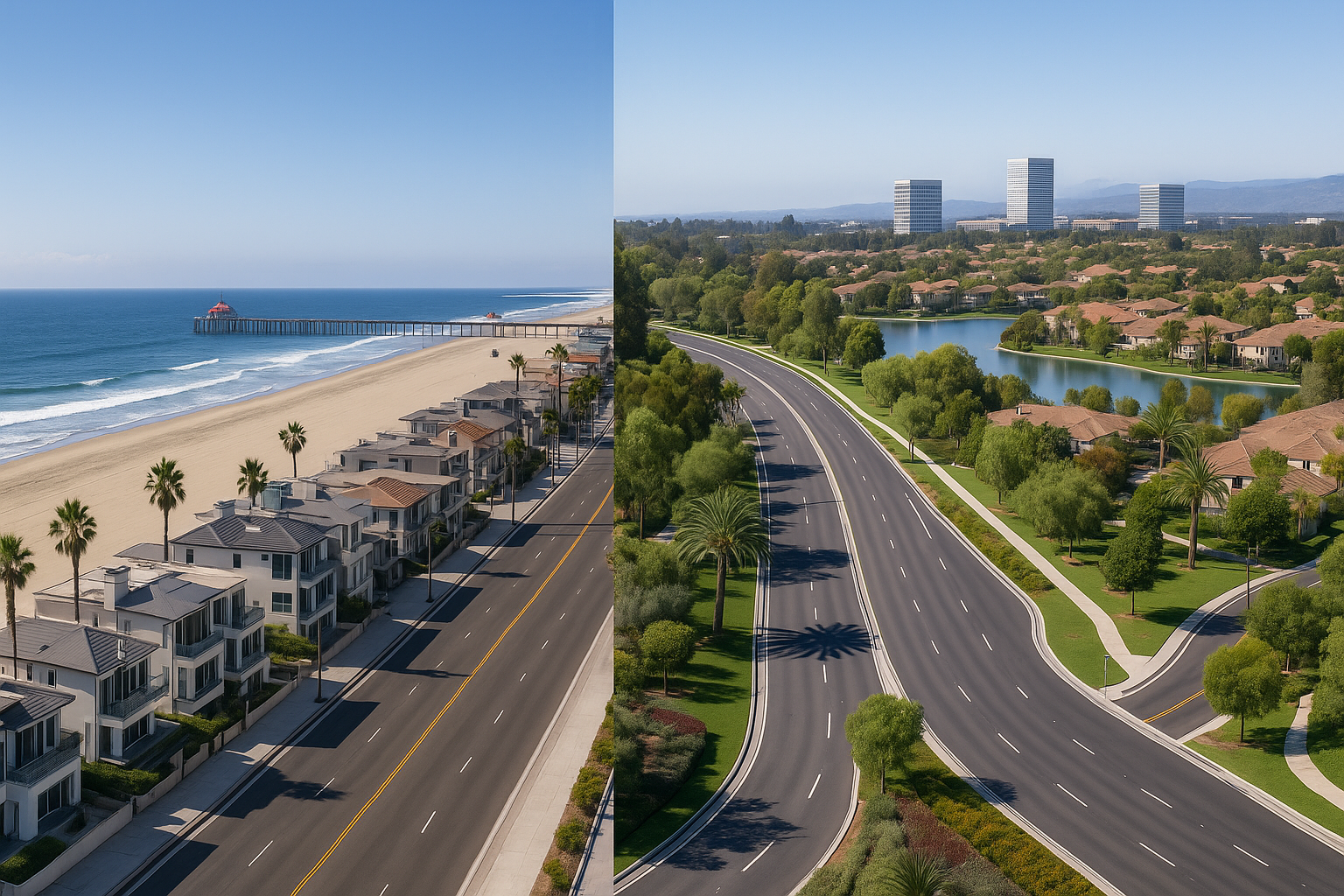
What's the difference between Huntington Beach and Irvine?
Huntington Beach is a coastal Orange County beach town with older, varied neighborhoods and ocean access, while Irvine is an inland master-planned city of newer villages, HOAs, and Mello-Roos near major job centers.
What's the difference between Huntington Beach and Irvine?
The short version: Huntington Beach is a coastal city built over many decades, with a wide range of neighborhoods, home ages, and styles, plus about nine and a half miles of Pacific coastline. Irvine is a landlocked, master-planned city organized into distinct villages, most of them newer, with homeowners associations and, in many tracts, Mello-Roos assessments. One is defined by the ocean and the other by planning.
These two Orange County cities attract very different buyers for very different reasons, and neither is objectively better. Huntington Beach gives you the beach, older architecture, and neighborhoods that vary block to block. Irvine gives you newer construction, uniform planning, and close proximity to some of the county's largest employment centers.
If you're comparing the two, the honest answer is that it comes down to what you value in daily life and what you want your money to buy. Justin and Craig Ratowsky work across coastal Orange County and see buyers land on both sides of this decision. The buyer resources on the site walk through how to weigh lifestyle against price, layout, and long-term equity.
Is Huntington Beach or Irvine better for your move?
Neither city wins on paper, because the two are answering different questions. Huntington Beach is better if coastal access, an established beach-town feel, and a mix of home ages matter most to you. Irvine tends to appeal to buyers who prioritize newer homes, a highly planned environment, and a short drive to job centers along the 5 and 405.
A useful way to frame it: Huntington Beach is a place you buy for the coastline and the character of individual neighborhoods. Irvine is a place you buy for the predictability of master-planned villages and the convenience of being near the Irvine Spectrum and UC Irvine.
Think like a long-term owner, not just a resident for the next year. Home age, carrying costs, and how a neighborhood holds its appeal over time all feed into equity. The Huntington Beach market overview is a good starting point if the coast is where you're leaning.
How does coastal access compare between the two?
This is the single clearest difference. Huntington Beach sits directly on the Pacific, with the HB Pier, Main Street, the Bolsa Chica wetlands, Huntington Harbour, and Sunset Beach all part of the city's coastal fabric. You can live within a short distance of sand in several parts of town, and waterfront living is a real category here, from harbor homes to oceanfront.
Irvine has no coastline. It's an inland city, and the nearest beaches, in places like Newport Beach or Laguna Beach, are a drive away rather than part of the city itself. That doesn't make Irvine lesser, it simply means the ocean is a destination there rather than a feature of the neighborhood.
If proximity to the water is a priority, the difference is decisive. Buyers focused on the coast often start with the Huntington Beach community page, and those drawn specifically to harbor and oceanfront homes can dig into the waterfront homes guide. The California Coastal Commission is a helpful reference for understanding how the coastal zone is managed and what that means for shoreline properties.
How are the neighborhoods structured in each city?
Irvine is famously master-planned, developed largely by a single company over decades. The city is organized into named villages, including Woodbridge, Turtle Rock, Northwood, University Park, Cypress Village, Portola Springs, Orchard Hills, and the newer Great Park Neighborhoods on the former MCAS El Toro site. Each village tends to have its own design standards, parks, and community amenities, which creates a consistent, planned feel across town.
Huntington Beach grew differently, layer by layer over many decades, which is why its neighborhoods vary so much. You'll find older beach cottages in Downtown and Old Town, mid-century tracts inland, harbor homes in Huntington Harbour, and newer master-planned pockets like Brightwater and SeaCliff. Two neighborhoods a few miles apart can feel like different worlds.
That variety is part of Huntington Beach's identity, and it rewards buyers who take the time to learn the map. Justin grew up moving around town, from near the wetlands to Central Park to Old Town, and that lived knowledge is why the communities section breaks HB down neighborhood by neighborhood rather than treating the city as one block.
How do home age, style, and construction differ?
Irvine skews newer. Because much of the city was built out in recent decades, and the Great Park Neighborhoods are still being developed, a large share of Irvine's homes are relatively young. That often means contemporary floor plans, newer building systems, attached and detached condos, townhomes, and current construction standards. For buyers who want a home that feels move-in modern, that consistency is appealing.
Huntington Beach spans a much wider range of eras. You'll see beach bungalows and remodeled cottages near the coast, 1960s and 1970s tract homes inland, custom harbor homes, and newer builds in the master-planned pockets. That range means more variety in layout, character, and price, but also more variation in how a given home has been maintained and updated over the years.
With older housing stock, understanding a property's true condition matters more, from roofs and systems to prior remodels. Buyers new to the coast often find the buying a home in Huntington Beach guide helpful for knowing what to look at before writing an offer.
How do the price tiers compare?
Both cities are premium Orange County markets, and neither is inexpensive. Rather than quote figures that shift month to month, it's more useful to understand the shape of each market. Huntington Beach runs a very wide range, from condos and inland single-family homes up through harbor and oceanfront estates that reach into the multimillions. Irvine also spans condos through large detached homes, with newer construction and village amenities factored into the price.
Because Huntington Beach includes waterfront and oceanfront categories, its top tier climbs higher than most of Irvine's inventory. On the entry side, both cities offer condos and townhomes, though what you get for the money differs, newer finishes in Irvine versus proximity to the coast in Huntington Beach.
Current numbers move with the market, so check live data before you draw conclusions. Redfin and the California Association of Realtors both publish city-level pricing and inventory you can compare side by side. For pricing strategy on a specific home or neighborhood, it's best to have a direct conversation with Craig and Justin Ratowsky so they can look at the details.
What should you know about HOAs and Mello-Roos?
Carrying costs beyond the mortgage are one of the biggest practical differences between these two cities. Irvine's master-planned villages come with homeowners associations in most cases, and many newer tracts also carry Mello-Roos, a special tax created under California's 1982 Mello-Roos Community Facilities Act to fund infrastructure like roads, schools, and parks in newer developments. Those assessments can add meaningfully to a monthly payment, and they vary by village and by year built.
Huntington Beach has HOAs too, especially in condo communities and newer master-planned neighborhoods like Brightwater and SeaCliff, but a large share of the city's older single-family tracts have no HOA at all. Mello-Roos is far less common across HB's established neighborhoods than it is in Irvine's newer villages, simply because so much of Huntington Beach was built before those districts became standard practice.
None of this is a reason to choose one city over the other on its own, but it should be part of the math. Two homes at the same purchase price can carry very different monthly costs once HOA dues and any special assessments are factored in. Before you commit, review the numbers carefully, the HOA document review guide explains what to look for in association budgets and disclosures.
How do commutes to Orange County job centers compare?
Irvine is itself one of the county's largest job centers. The Irvine Spectrum business district, UC Irvine, and a dense cluster of tech, finance, and corporate offices mean many Irvine residents have a short commute, and the city sits at the crossroads of the 5, 405, 133, 261, and 73. For buyers whose work is in central or southern Orange County, that central location is a real advantage.
Huntington Beach sits on the coast, closer to the 405 than the 5, and further from the Irvine Spectrum and Great Park employment core. Commuters heading to those inland job centers should budget for more drive time, particularly at peak hours. On the other hand, HB is convenient to job centers in west and north Orange County and to the coast itself.
The right answer depends entirely on where you work and how you feel about a daily drive. If your job is anchored near UC Irvine or the Spectrum, Irvine's location is hard to beat. If your work is more flexible or west-county based, Huntington Beach keeps you near the water without a punishing commute.
How walkable and amenity-rich is each area?
The two cities deliver amenities in different ways. Irvine's villages are built around planned parks, community pools, greenbelts, and retail centers, with the Irvine Spectrum Center as a major shopping and dining destination and the Orange County Great Park continuing to expand on the former air station. The planning creates a consistent, amenity-forward environment throughout town.
Huntington Beach concentrates a lot of its energy along the coast. Downtown and Main Street near the HB Pier offer restaurants and shops close to the sand, Central Park is one of the largest city parks in the region, and the beach path draws walkers and cyclists year-round. Walkability is very neighborhood-specific in HB, high near Downtown and the harbor, more car-oriented in the inland tracts.
So the comparison isn't more versus less, it's planned-and-uniform versus coastal-and-varied. Buyers who want everything organized within a village lean toward Irvine, while those who want the beach and a lively downtown lean toward Huntington Beach.
What factors should you weigh when choosing between them?
When buyers ask Justin and Craig how to decide, the conversation usually comes down to a handful of concrete trade-offs. Rank these in the order that matters to your household, and the answer tends to reveal itself.
Work through them honestly, and use live data where price and inventory are involved rather than assumptions.
- Coastal access: Huntington Beach has miles of coastline and waterfront homes. Irvine has none and treats the beach as a drive-to destination.
- Home age and style: Irvine skews newer and more uniform. Huntington Beach spans cottages, mid-century tracts, harbor homes, and newer builds.
- Neighborhood structure: Irvine is master-planned villages with consistent design. Huntington Beach varies block to block.
- Carrying costs: Irvine's newer villages often carry HOA dues and Mello-Roos. Many older Huntington Beach tracts have no HOA and rarely Mello-Roos.
- Commute: Irvine sits at the center of major job centers and freeways. Huntington Beach is coastal and further from the Spectrum and Great Park core.
- Price ceiling: Huntington Beach's waterfront and oceanfront tiers climb higher than most Irvine inventory, while both offer condos on the entry side.
- Long-term equity: think like an investor, not just a resident, and weigh how each area's inventory and demand may hold up over time.
How do the two markets behave differently?
Because the inventory is so different, the two markets can move at different speeds. Irvine's steady flow of newer construction and resale in planned villages tends to create a large, comparable pool of homes, which helps buyers benchmark value across similar floor plans. Huntington Beach's variety means comps require more nuance, since a harbor home, a Downtown cottage, and an inland tract home behave like separate markets.
Coastal scarcity is a real factor in Huntington Beach. Waterfront and oceanfront homes are a finite category, which is part of why well-prepared, well-priced listings on the water can draw strong competition. When presentation, pricing, and timing line up, demand can concentrate quickly.
Understanding these dynamics is where local experience earns its keep. Ratowsky Group has been selling in Huntington Beach and across coastal Orange County for years, and Justin has watched the town's neighborhoods change since childhood. That perspective helps buyers read a specific street rather than a citywide average.
Which city fits which kind of buyer?
Rather than declaring a winner, it helps to match each city to what a buyer is optimizing for. If your priority is the ocean, an established beach-town feel, and neighborhoods with distinct personalities, Huntington Beach is the natural fit. If your priority is newer construction, a highly planned environment, and proximity to central job centers, Irvine makes a strong case.
Plenty of buyers tour both before deciding, and that's a smart move. Seeing a master-planned village next to a varied HB neighborhood makes the trade-offs tangible in a way no article can. Justin often walks relocation buyers through several areas in person so they can feel the difference firsthand.
When you're ready to compare specific homes, layouts, and carrying costs side by side, reach out to Craig and Justin Ratowsky for a local, no-pressure conversation through the contact page.
One verified number worth knowing: Sale price for 3801 Seascape on Trinidad Island in Huntington Harbour, up from a roughly $2.45M estimate, with 12 offers in 8 days and about $643K over asking: $3,925,000 (source: Ratowsky Group at Compass).
As Justin Ratowsky, Realtor, DRE #02026158, Ratowsky Group at Compass puts it: "Huntington Beach has a lot of personality, and it doesn't show up the same way in every neighborhood. The block I grew up on feels different than Huntington Harbour, which feels different than Sunset Beach. Comparing a beach town to a master-planned city isn't about which is better, it's about which one fits how you actually want to live."
Sources
Frequently asked questions
- Is Huntington Beach or Irvine more expensive?
- Both are premium Orange County markets, and current pricing shifts month to month, so check live data before drawing conclusions. Huntington Beach's top tier climbs higher because it includes waterfront and oceanfront homes, while Irvine's newer construction and village amenities factor into its prices. On the entry side, both offer condos and townhomes at comparable levels.
- Does Irvine have a beach?
- No. Irvine is a landlocked, inland city with no coastline of its own. The nearest beaches, in cities like Newport Beach or Laguna Beach, are a drive away, whereas Huntington Beach sits directly on the Pacific with about nine and a half miles of coastline.
- Which has lower HOA fees, Huntington Beach or Irvine?
- It varies by neighborhood, but many older single-family tracts in Huntington Beach have no HOA at all, while most of Irvine's master-planned villages include HOA dues and often Mello-Roos assessments. Newer Huntington Beach communities like Brightwater and SeaCliff do carry HOAs. Always review the specific home's dues and any special taxes before you buy.
- Is Huntington Beach older than Irvine?
- Generally, yes. Huntington Beach was built out over many decades and has a wide mix of home ages, from beach cottages to mid-century tracts to newer builds. Irvine developed largely in recent decades as a master-planned city, so its housing stock skews newer and more uniform, with the Great Park Neighborhoods still being built.
- What is Mello-Roos and does Huntington Beach have it?
- Mello-Roos is a special tax created under California's 1982 Community Facilities Act to fund infrastructure like roads, schools, and parks in newer developments. It is common in Irvine's newer villages and far less common across Huntington Beach's older, established neighborhoods. When it applies, it adds to your monthly carrying cost, so confirm it during your review of any home.
- How far is Irvine from Huntington Beach?
- The two cities are roughly a 20 to 30 minute drive apart depending on traffic and route, typically via the 405. Commute times swing significantly at peak hours, so if you'd be driving between the coast and Irvine's job centers regularly, budget for more time during rush periods.
Topics
- best Huntington Beach realtor
- best Huntington Beach real estate agent
- Huntington Beach realtor
- Huntington Beach real estate agent
- Huntington Beach real estate broker
- Ratowsky Group
- Justin Ratowsky realtor
- Justin Ratowsky Huntington Beach realtor
- Compass Huntington Beach