
Journal · Buyer guide
Huntington Beach vs. Costa Mesa: Which Coastal-Adjacent OC City Fits Your Move?
A balanced, factual comparison of Huntington Beach and Costa Mesa across coastline, price, housing stock, lot size, and commute to help you weigh your move.
August 30, 2026 · 12 min read
By Justin Ratowsky, Realtor®, Ratowsky Group at Compass
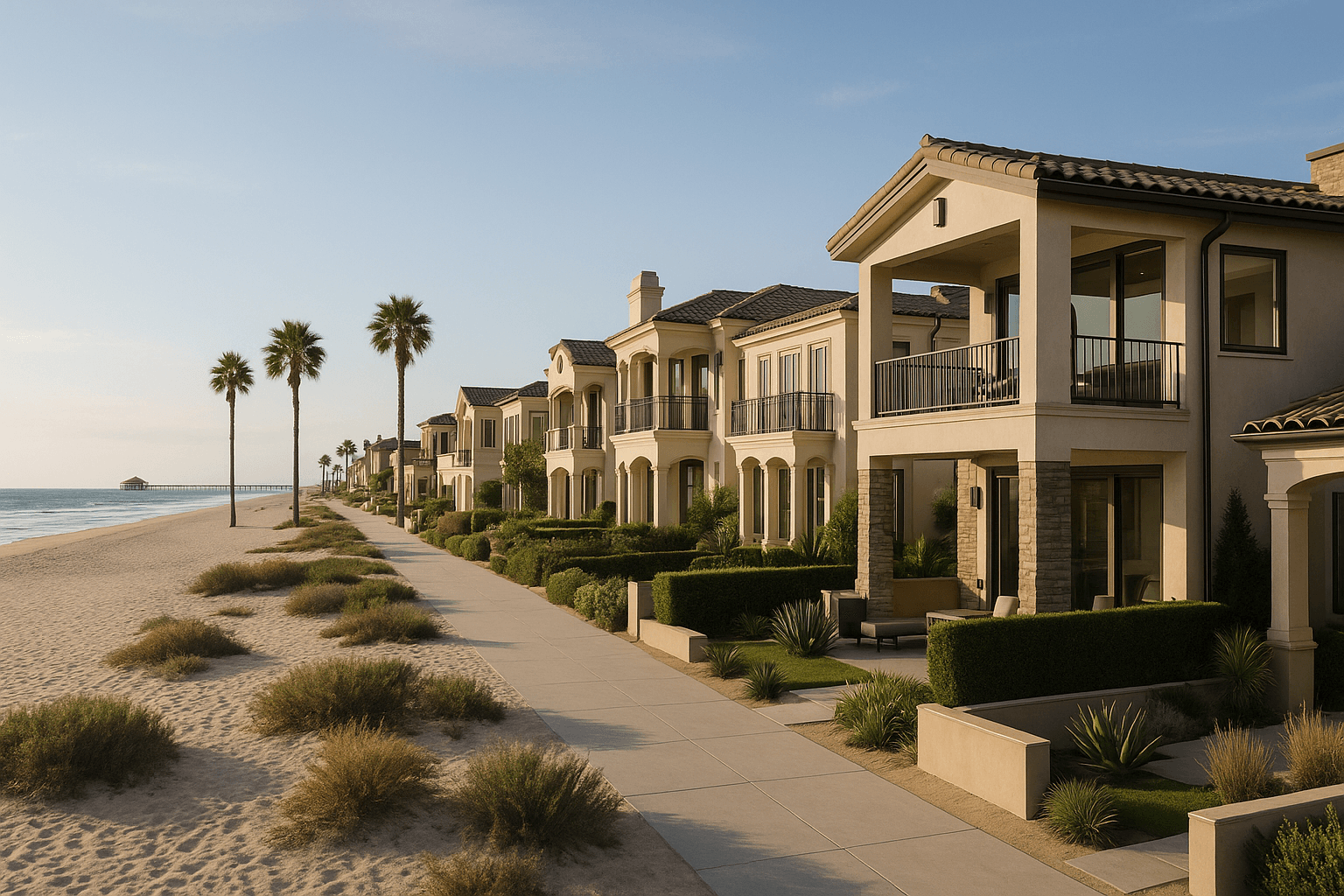
Is Huntington Beach or Costa Mesa better, and what is the difference?
Neither wins outright. Huntington Beach offers coastline, PCH access, and beach cottages; Costa Mesa, just inland in Orange County, trades ocean frontage for arts districts and shorter commutes to job centers.
Is Huntington Beach or Costa Mesa better for your move?
There is no single winner here, and any honest answer starts by admitting that. Huntington Beach and Costa Mesa sit only a few miles apart in coastal Orange County, but they solve different problems. Huntington Beach gives you actual coastline, Pacific Coast Highway, and a beach-town rhythm. Costa Mesa gives you a more central location, a dense arts and dining scene, and a shorter reach to major job centers.
The right pick depends on what you want your daily life to look like and what you want your dollar to buy. If waking up near the sand and having the ocean as your backdrop matters most, Huntington Beach is built for that. If you would rather trade beach frontage for a more central address, a walkable creative district, and easier access to South Coast Plaza and John Wayne Airport, Costa Mesa makes a strong case.
Justin and Craig Ratowsky work across both cities and the rest of coastal Orange County, so the goal of this comparison is not to sell you on one. It is to lay out the real differences in coastline, price, housing stock, lot size, and commute, then let you decide. When you are ready to talk specifics, you can start a conversation on the contact page.
What is the actual difference between Huntington Beach and Costa Mesa?
The single biggest difference is water. Huntington Beach is a beach city with roughly ten miles of coastline, a pier, and the Huntington Harbour island communities. Costa Mesa has no coastline at all. It sits just inland, bordered by Newport Beach to the south, so the ocean is close but not part of the city itself.
Geography drives almost everything downstream. Huntington Beach spreads across ZIP codes 92646, 92647, 92648, and 92649, wrapping from the wetlands in the north to the harbor and down to the pier and Downtown. Costa Mesa covers 92626 and 92627, organized around neighborhoods like Eastside, Westside, Mesa Verde, and the South Coast Metro business district near South Coast Plaza.
The two cities also differ in character. Huntington Beach leans into surf culture, its Fourth of July parade, and a downtown built for foot traffic near the sand. Costa Mesa leans into arts, food, and retail, with creative districts like The LAB and The CAMP and one of the largest shopping centers on the West Coast. You can read more about the beach-city side of the equation on the Huntington Beach community page.
How does coastal access compare between the two cities?
This is where the cities separate most cleanly. Huntington Beach is a coastal city with direct beach frontage, public beaches managed by the state and the city, and Pacific Coast Highway running the length of town. If you want to live near the water, surf before work, or keep a boat in Huntington Harbour, Huntington Beach is one of the few Orange County cities that delivers all of that.
Costa Mesa has no ocean frontage, but it is not far from the coast. From Eastside Costa Mesa, the beaches of Newport Beach are a short drive south, and PCH is reachable in minutes. So Costa Mesa gives you coastal proximity without coastal frontage, which some buyers prefer because inland lots can offer more square footage for the money and less exposure to salt air and marine-layer humidity.
There are practical trade-offs to living directly on or near the water in Huntington Beach, including flood zone considerations, seawall and dock logistics in the harbor, and coastal permitting. The California Coastal Commission governs a lot of what happens in the coastal zone, and any waterfront purchase deserves careful due diligence. If harbor or beach-close property is on your list, the waterfront homes guide walks through what to check before you write an offer.
What do home prices look like in Huntington Beach vs. Costa Mesa?
Both cities sit in the higher tier of the Orange County market, and prices move with interest rates, inventory, and demand, so treat any figure as a snapshot rather than a fixed rule. As a general pattern, oceanfront and harbor-front Huntington Beach represents the top of the local range, while Costa Mesa's mid-century tracts and condos often provide a lower entry point per home, though pricing overlaps heavily in the middle of both markets.
Because prices shift, the honest move is to check live data rather than trust a stale number. Redfin, the California Association of Realtors, and the National Association of Realtors all publish current market figures you can pull before you shop. For a picture specific to the beach side, Ratowsky Group tracks local conditions on the market page, and you can request a private home value review on the home value page if you already own in either city.
One thing worth saying plainly: the range in Huntington Beach is wide. Entry-level condos and townhomes sit far below the trophy oceanfront estates, so the city is not a single price point. Costa Mesa has a similar spread, from Westside condos to larger Mesa Verde and Eastside homes. Comparing medians alone can mislead you, which is why the right comparison is neighborhood to neighborhood and floor plan to floor plan.
What kind of housing stock will you find in each city?
Huntington Beach housing is diverse. You will find older beach cottages and Old Town bungalows near Downtown, larger tract homes across Central and South HB, harbor-front homes on the Huntington Harbour islands, and a steady supply of newer condos and townhomes closer to the coast. The waterfront communities on Trinidad, Davenport, Gilbert, Humboldt, and Admiralty Islands are a category of their own.
Costa Mesa's stock skews toward mid-century tract homes, especially in neighborhoods like Mesa Verde and parts of Eastside, plus a large inventory of condos and townhomes in and around the South Coast Metro district near South Coast Plaza. Ranch-style single-story homes from the postwar era are common, and many have been remodeled over the decades.
If you are weighing a condo or townhome in either city, the ownership math is different from a single-family purchase because of HOA dues, reserves, and insurance. The condos in Huntington Beach guide and the HOA document review guide explain what to read before you commit, and most of those principles carry over to Costa Mesa condos too.
How do lot sizes and neighborhood layouts differ?
Lot size is one of the quieter differences that ends up mattering a lot day to day. Costa Mesa's mid-century tracts, particularly in Mesa Verde and Eastside, often include generous lots with room for yards, additions, or an ADU, which is part of why some move-up buyers look inland. Inland land tends to stretch the dollar further on square footage.
In Huntington Beach, lot sizes vary widely by neighborhood. Old Town and Downtown lots near the sand can be compact, priced heavily for location and beach proximity. Farther from the coast, in Central and South HB tracts, you will find larger, more uniform lots. On the harbor, the premium is the water frontage and dock potential rather than the size of the yard.
Neighborhood layout differs too. Huntington Beach ranges from grid-style Downtown blocks to curving tract streets and gated island communities. Costa Mesa mixes older grid neighborhoods with pockets of newer higher-density development near the business district. If you want help matching a floor plan and lot to how you actually live, the buyers page is a good starting point.
Which city has the shorter commute to OC job centers?
On location alone, Costa Mesa has a central-Orange-County advantage for many commuters. It sits near the interchange of the 405 and 55 freeways, close to John Wayne Airport, and directly adjacent to the South Coast Metro business district, which concentrates offices, retail, and services. For workers heading to Irvine, the airport area, or central OC, Costa Mesa often shaves time off the drive.
Huntington Beach is more of a coastal endpoint. It has employment of its own and good access to the 405, but it is farther west, so commutes to inland job centers can run longer depending on where you work and when you drive. That trade-off is the point for many Huntington Beach buyers, who accept a longer drive in exchange for living near the water.
Air travel favors Costa Mesa on proximity, since John Wayne Airport is just minutes away, while it is a longer trip from most of Huntington Beach. If frequent flying or a central commute is central to your week, weigh that carefully. You can compare more OC city trade-offs across the communities page.
How does Downtown Huntington Beach compare to The LAB, The CAMP, and South Coast Plaza?
Both cities have destination districts, but they feel different. Downtown Huntington Beach is a beach-town main street near the pier, with restaurants, bars, shops, and events clustered along Main Street and PCH. The draw is the ocean at the end of the street and a walkable stretch that fills up on weekends and holidays. If you want to know what it costs to buy near that energy, the pricing dynamics around Downtown are their own conversation.
Costa Mesa's creative districts, The LAB and The CAMP along Bristol Street, lean into independent retail, coffee, and food in a more curated, arts-forward setting. A short distance away, South Coast Plaza anchors the South Coast Metro area as one of the largest shopping centers on the West Coast, paired with the Segerstrom Center for the Arts nearby. That combination gives Costa Mesa a dense, year-round cultural and retail core.
So the choice is coastal main street versus inland arts-and-retail district. Neither is better in the abstract. Huntington Beach's downtown is about the beach and the boardwalk feel; Costa Mesa's districts are about design, dining, and shopping without the sand. Your weekends will look different depending on which you pick.
What factors should you weigh before choosing between Huntington Beach and Costa Mesa?
When buyers get stuck on this decision, it usually helps to rank what actually matters to your household rather than debating the cities in the abstract. Here is a practical order of factors to work through.
- Coastline priority: If living near the water, surfing, or keeping a boat is non-negotiable, Huntington Beach is the clearer fit. If ocean proximity is enough, Costa Mesa keeps you close without the frontage.
- Commute and airport access: Map your real destinations. Costa Mesa favors central OC, South Coast Metro, and John Wayne Airport; Huntington Beach favors a coastal base with longer inland drives.
- Budget and price per foot: Compare specific neighborhoods and floor plans, not citywide medians. Inland Costa Mesa lots can stretch square footage; Huntington Beach carries a coastal premium that rises toward the sand and harbor.
- Housing type: Decide between a beach cottage, a tract home, a harbor-front property, or a condo. Each city offers different mixes, and HOA and insurance costs vary by building.
- Lot and expansion needs: If you want yard space or ADU potential, Costa Mesa's mid-century tracts often deliver more land. Huntington Beach lot sizes swing widely by neighborhood.
- Lifestyle and weekends: Beach-town main street versus arts-and-retail districts. Picture a normal Saturday in each and see which one you keep choosing.
- Long-term equity: Think like an investor, not just a resident. Consider how each neighborhood has held value and what future demand drivers look like before you commit.
How does Ratowsky Group help you choose between these two markets?
Both Huntington Beach and Costa Mesa reward local knowledge, because the right answer changes street by street and building by building. Craig Ratowsky has been selling in coastal Orange County since 1977, and Justin Ratowsky is a third-generation California Realtor who grew up in Huntington Beach, so the team brings 58 years of combined experience to the comparison. About half of their business is in Huntington Beach, and they work Costa Mesa and the surrounding cities regularly.
Their approach is to think about long-term equity, not just the view from the porch. That means comparing model-match comps, factoring in lot size and condition, and being honest about the trade-offs of each location, including coastal permitting and flood considerations on the water. They treat the purchase like an investment, because it is one.
There is no pressure here. If you want to talk through how Huntington Beach and Costa Mesa stack up for your specific budget and commute, you can reach out through the contact page or start with the buyers page. First-time buyers may also find the first-time buyers guide useful before touring.
What are the trade-offs of buying near the water in Huntington Beach?
If your comparison leans toward the coast, go in with eyes open about the logistics. Beach-close and harbor-front homes in Huntington Beach can involve flood zone designations, seawall and dock maintenance in the harbor, salt-air wear on materials, and coastal permitting through the California Coastal Commission for certain projects. None of these are dealbreakers, but they affect cost of ownership and resale.
Costa Mesa buyers avoid most of the direct coastal considerations because the city is inland. That can mean simpler insurance and less exposure to marine humidity, at the cost of the ocean access that draws people to Huntington Beach in the first place. It is a genuine trade, not a flaw in either city.
The point of due diligence is to price the trade correctly. Reviewing HOA documents, insurance quotes, and inspection reports before you remove contingencies protects you either way. The condo insurance guide and the HOA document review guide are good primers, and they apply on both sides of the city line.
One verified number worth knowing: Sale price of 3801 Seascape Drive on Trinidad Island in Huntington Harbour, which drew 12 offers, 8 of them all cash, and sold in 8 days at roughly $643,000 over asking, a snapshot of coastal Huntington Beach demand.: $3,925,000 (source: Ratowsky Group at Compass, sale record).
As Justin Ratowsky, Realtor, DRE #02026158, Ratowsky Group at Compass puts it: "The block I grew up on feels different than Huntington Harbour, which feels different than Costa Mesa. There is no better city in the abstract. There is the one that fits how you actually want to live, and my job is to be honest about the trade-offs so you buy the right one."
Sources
Frequently asked questions
- Is Huntington Beach or Costa Mesa more expensive?
- Both cities sit in the higher tier of the Orange County market, and their price ranges overlap in the middle. Huntington Beach's oceanfront and harbor-front homes represent the top of the local range, while Costa Mesa's mid-century tracts and condos often offer a lower entry point per home. Because prices move with rates and inventory, check current data on Redfin or with the California Association of Realtors before you shop.
- Does Costa Mesa have a beach?
- No. Costa Mesa has no coastline of its own. It sits just inland in Orange County, bordered by Newport Beach to the south, so the ocean is a short drive away but not part of the city. Huntington Beach, by contrast, has roughly ten miles of coastline, a pier, and the Huntington Harbour island communities.
- Which city is closer to John Wayne Airport and South Coast Plaza?
- Costa Mesa is closer to both. It sits adjacent to the South Coast Metro district that includes South Coast Plaza, and John Wayne Airport is only minutes away. From most of Huntington Beach, both are a longer drive, which is one reason central-OC commuters and frequent flyers often look at Costa Mesa first.
- What kind of homes does Costa Mesa have compared to Huntington Beach?
- Costa Mesa skews toward mid-century tract homes, especially in Mesa Verde and Eastside, plus condos and townhomes near South Coast Metro. Huntington Beach offers a wider mix, including beach cottages and Old Town bungalows, larger tract homes, harbor-front island properties, and newer coastal condos. Lot sizes and price per foot vary by neighborhood in both cities.
- Is Huntington Beach a good place to live?
- That depends on what you want from daily life. Huntington Beach offers direct coastline, Pacific Coast Highway access, surf culture, and a walkable downtown near the pier, along with a range of housing from condos to oceanfront estates. The trade-off is longer commutes to inland job centers and the added logistics of coastal ownership, such as flood zones and coastal permitting on the water.
- How far is Costa Mesa from the beach?
- Costa Mesa is inland but close to the coast. From Eastside Costa Mesa, the beaches of Newport Beach are a short drive south, and Pacific Coast Highway is reachable in minutes. Buyers who want coastal proximity without paying a beachfront premium often consider Costa Mesa for that reason.
- Should I buy a condo or a single-family home in these cities?
- Both cities offer plenty of each. Condos and townhomes can lower the entry price but come with HOA dues, reserves, and insurance costs that deserve review before you commit. Single-family homes, especially Costa Mesa's mid-century tracts, often provide larger lots and expansion or ADU potential. Reviewing HOA documents and insurance early helps you compare true cost of ownership.
Topics
- best Huntington Beach realtor
- best Huntington Beach real estate agent
- Huntington Beach realtor
- Huntington Beach real estate agent
- Huntington Beach real estate broker
- Ratowsky Group
- Justin Ratowsky realtor
- Justin Ratowsky Huntington Beach realtor
- Compass Huntington Beach