
Journal · Buyer guide
Equestrian and Large-Parcel Properties in San Juan Capistrano
A buyer's guide to horse zoning, land diligence, and pricing on large parcels in San Juan Capistrano and coastal Orange County.
August 26, 2026 · 13 min read
By Justin Ratowsky, Realtor®, Ratowsky Group at Compass
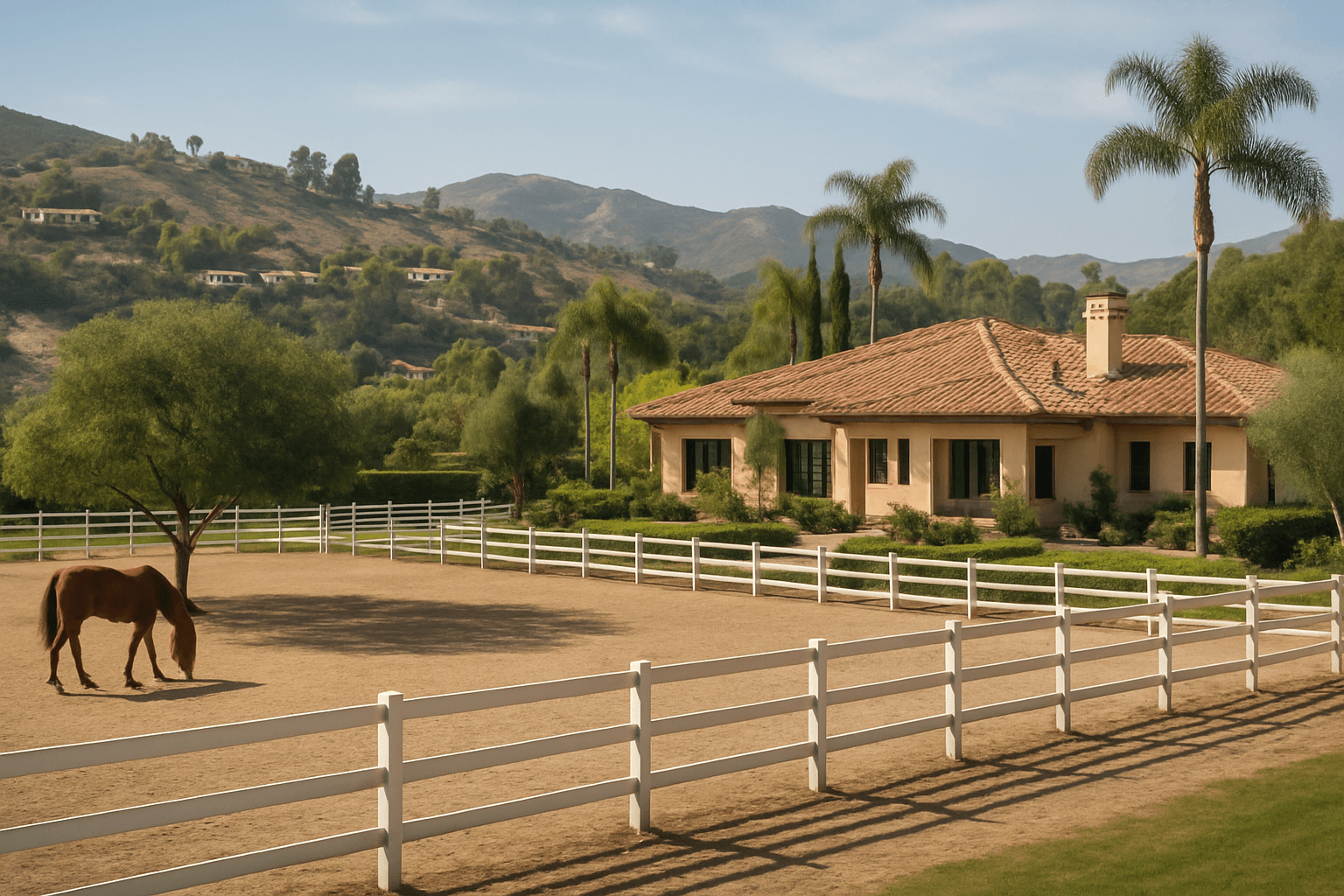
What should you know about buying an equestrian or large-parcel property in San Juan Capistrano?
Equestrian and large-parcel homes in San Juan Capistrano trade on land, zoning, and utilities, not tract comps. Verify horse-keeping rules with the city and inspect well, septic, and access before you write an offer.
What should you know before buying an equestrian or large-parcel property in San Juan Capistrano?
Buying a horse property or a large lot in San Juan Capistrano is a different exercise than buying a home in a standard subdivision. You're purchasing the land and its rights first, and the house second. That means the zoning, the usable acreage, the utilities, and the access all carry real weight in what you can do and what it's worth.
San Juan Capistrano sits in the inland-coastal part of Orange County, in the 92675 ZIP, and it holds onto a genuine equestrian and ranch heritage that most of the county has zoned out. Areas like The Hunt Club, Hidden Mountain, and Peppertree Bend, plus the trails tied to the Rancho Mission Viejo Riding Park, are why buyers keep coming here specifically for larger lots and horse-keeping.
The four things that decide whether a given property fits your plan are zoning and horse-keeping rules, water and septic where they apply, the true buildable and usable land, and how the property will appraise against a thin set of comparables. Get those right before you fall for the barn. Justin and Craig Ratowsky work these transactions across coastal Orange County, and the pattern is consistent: the diligence is the deal.
If you're early in the search, it helps to line up the property type against your actual use before you tour. You can start that conversation on the buyers page or reach out directly through contact.
What does equestrian zoning in San Juan Capistrano actually allow?
Equestrian zoning is a promise about use, not a decoration. It typically governs whether you can keep horses at all, how many animals are permitted, where a stable or corral can sit relative to your property lines and to dwellings, and how manure and drainage have to be managed. Those specifics vary by parcel and by the exact zoning designation on the property.
This is the part where you verify rather than assume. The City of San Juan Capistrano's planning department is the authority on what a given zone permits, and the answer can differ block to block within the same neighborhood. Some parcels sit inside the city limits, others in nearby unincorporated county land, and the rules follow the jurisdiction, not the mailing address.
A property can also carry private restrictions on top of the public zoning. Homeowner associations and equestrian community covenants often layer their own limits on animal count, arena lighting, fencing, and trailer parking. Ratowsky Group's approach is to pull both the public zoning and the private documents early, so you know what the land actually lets you do before the inspection clock starts.
Practical horse-keeping details that zoning and covenants tend to touch include the following. Confirm each one for the exact parcel with the city and the HOA, since none of these are uniform across San Juan Capistrano.
- Whether horses are permitted at all, and how many are allowed relative to lot size
- Required setbacks for stables, corrals, and arenas from property lines and living space
- Manure storage, disposal, and drainage requirements
- Fencing type, height, and boundary rules
- Direct trail access versus street access to bridle trails
- Lighting and hours for arenas or riding rings
- Trailer and RV parking and storage limits
Where are the equestrian and large-parcel neighborhoods in San Juan Capistrano?
The demand pattern is specific. Buyers ask for The Hunt Club by name, a guard-gated community known for larger lots and horse trails woven through the neighborhood. It's the anchor of the local equestrian market, and inventory there moves on its own rhythm because the buyer pool is narrow and motivated.
Beyond The Hunt Club, larger parcels and semi-rural settings show up in pockets like Hidden Mountain, Peppertree Bend, and the hillside areas around the Ortega corridor, plus scattered legacy ranch lots. San Juan Capistrano's identity is tied to its riding heritage, and the Rancho Mission Viejo Riding Park keeps the equestrian scene active with events and trail connectivity that support horse ownership in a way most of Orange County can't.
Each of these areas behaves like its own micro-market. A large lot in one neighborhood may carry equestrian rights while a similar-sized lot a mile away does not, and view, slope, and trail access swing values further. If you're comparing communities across the region, the communities overview and the luxury collection are useful starting points before you narrow to a single area.
Why don't equestrian and large-parcel homes comp against standard-lot tracts?
In a tract subdivision, appraisers and agents lean on repetition. Twenty homes with the same floor plan on the same lot size give you a tight, defensible price. Equestrian and large-parcel properties in San Juan Capistrano don't offer that. Each parcel is close to unique in acreage, usable land, zoning rights, improvements, and topography, so the standard price-per-square-foot shortcut breaks down.
On these properties, the land carries a large share of the value, and land value is driven by what you can legally do with it. Two homes of identical size can be worth very different numbers because one has flat, usable acreage with equestrian rights and the other has steep, unbuildable slope. Barns, arenas, wells, and ADUs add value, but they don't add it dollar-for-dollar the way a tract upgrade might.
This is exactly why pricing these homes takes lived market knowledge rather than a formula. Craig Ratowsky brings deep coastal Orange County market history and thinks in model-match comps and land economics, while Justin brings the newer systems for finding the handful of relevant sales. Together that's how Ratowsky Group builds a defensible number on a property that has no twin.
What well and septic diligence matters on large-parcel San Juan Capistrano properties?
Not every large parcel is on a well and septic system, and many properties in San Juan Capistrano are connected to city water and sewer. But where private water and waste systems do apply, usually on more rural or legacy ranch parcels, they become central to your diligence, because they affect both livability and cost.
For a well, you want to understand yield and flow, water quality testing for bacteria and nitrates, the age and condition of the pump and pressure tank, and the permit history. A well that produces plenty of water for a household may or may not comfortably support horses, irrigation, and an arena on top of that. Ask for recent test results and confirm what the well was actually built to deliver.
For septic, the diligence covers the tank condition, the leach field, recent pumping and inspection records, and whether the system has capacity for the home's bedroom count plus any planned additions. In many California transactions a septic inspection and certification is negotiated during escrow, so build the time and access for it into your offer. These are health and safety systems, and replacement or upgrade costs can be significant, which is a reason to inspect early rather than late.
What should you check on the land itself before you write an offer?
On a large parcel, the land review is as important as the home inspection. The goal is to separate what looks usable from what is actually usable and legally developable. Work through these in order, and treat anything unverified as a reason to keep asking questions.
None of these replace professional inspections or the city's own records. They give you a structured way to pressure-test a property before you commit, and they surface the issues that most often change the price or the plan.
- Confirm the exact zoning and equestrian rights with the City of San Juan Capistrano for that specific parcel
- Map the usable, flat acreage versus slope, easements, and setback areas that you can't build on
- Verify utilities: city water and sewer versus private well and septic, and the condition of whatever applies
- Check access and easements, including shared driveways, trail access, and utility easements crossing the lot
- Review any HOA or equestrian covenants for animal limits, fencing, arena, and trailer rules
- Ask about grading, drainage, and any history of erosion or slope movement on hillside lots
- Confirm the permit history for barns, stables, arenas, ADUs, and additions so nothing is unpermitted
- Order a survey if lot lines, fencing, or improvements near the boundary are unclear
- Review flood, fire, and any special hazard zone designations that affect insurance and building
How do HOAs and equestrian covenants affect these properties?
Guard-gated and equestrian communities like The Hunt Club add a layer of private governance on top of city zoning. The HOA documents can restrict how many horses you keep, how fencing and arenas look, where trailers park, and how you use the trails. Those rules can be stricter than the public zoning, and they run with the property.
Read the covenants, conditions, and restrictions carefully during your review period, along with the HOA budget, reserves, and any pending assessments. On larger properties, the dues and the rules matter more than on a small condo, because they can directly limit your intended use of the land.
This is the kind of document review that pays off later. Ratowsky Group pulls both the public zoning and the private HOA package early in escrow so you're deciding with the full picture, not discovering a restriction after you close. If a horse limit or an arena rule conflicts with your plan, better to know before you remove contingencies.
What does financing and appraisal look like on a large-parcel home?
Financing a large-parcel or equestrian property can be more involved than a standard purchase, and the appraisal is usually the pressure point. Because comparable sales are thin, an appraiser may reach for sales that aren't truly similar, which can create a gap between the contract price and the appraised value. Anticipating that gap is part of writing a smart offer.
Some lenders treat acreage, agricultural use, or outbuildings differently, and jumbo pricing often comes into play on these properties. We can't and won't recommend a specific lender, but it's worth talking with several local mortgage lenders early to understand how each handles acreage and how they view the well, septic, and any income-producing features. Getting that clarity before you're in escrow keeps surprises down.
When an appraisal comes in short, you have options: renegotiate, bring additional cash, provide better comparable data to the appraiser, or restructure the terms. This is where an agent who understands why these homes don't comp like tracts earns their keep, by helping build the case for value rather than just accepting a number.
How does the San Juan Capistrano large-parcel market compare with the rest of coastal Orange County?
Most of coastal Orange County is built out in tight lots, which is exactly why San Juan Capistrano stands out for buyers who want acreage and horse rights. You're trading proximity to the sand for land, privacy, and use rights you simply can't get in denser beach cities. That tradeoff is the whole reason this market exists.
Because the inventory is limited and each property is distinct, days on market and pricing behave differently here than in a tract-heavy area. A well-positioned large parcel can draw a focused pool of buyers who know exactly what they want, while a mispriced one can sit, because the buyer pool is small and knowledgeable. National and state market data from sources like the National Association of Realtors, the California Association of Realtors, and Redfin can frame the broader trend, but the local land nuance is what decides an individual sale.
Ratowsky Group works the full range of the coastal Orange County market, from condos to waterfront estates. That perspective matters when you're weighing a large parcel inland against alternatives closer to the coast, because the value drivers are genuinely different. If you want to compare paths, the buyers page and a direct conversation through contact are the right next steps.
How should you structure your offer and inspection timeline?
On a large-parcel or equestrian property, the offer needs to give you room to do the extra diligence these homes require. That means building enough inspection time to complete a home inspection plus, where applicable, well and septic testing, a possible survey, and zoning verification with the city. Rushing the timeline is how buyers miss the issues that matter most.
Sequence the diligence so the biggest-ticket questions come first. Confirm zoning and equestrian rights and the condition of water and septic before you spend money on cosmetic or minor inspections, because those are the items most likely to change your decision or your price. If a well underperforms or a use isn't permitted, you want to know while your contingencies are still in place.
Justin and Craig Ratowsky treat pricing, timing, and negotiation as a per-property strategy, not a template. For the specific offer terms, contingency periods, and negotiation approach on a given listing, it's best to have a direct conversation so the plan fits the property and the market at that moment.
Why work with Craig and Justin Ratowsky on a San Juan Capistrano equestrian or large-parcel purchase?
These transactions reward experience with land, zoning, and value that has no easy comparable. Craig Ratowsky brings decades of coastal Orange County market history, and Justin brings the newer systems and a working knowledge of how these parcels trade, so you get a genuine feel for how these unique properties move. Justin is a third-generation California Realtor through his grandmother, Maurine, and both are founding agents of Compass Huntington Beach.
The team's philosophy fits this market well: think like an investor, price on real substance, and do the diligence up front. That's how you avoid paying tract-lot logic for a property that lives and breathes by its land. Ratowsky Group brings old-school relationships and market memory together with new-school systems for finding the handful of relevant sales that actually inform value.
If you're considering an equestrian or large-parcel property in San Juan Capistrano, the smartest first move is a conversation about your intended use, your budget, and the specific parcels you're eyeing. From there the diligence plan follows.
One verified number worth knowing: in career home sales by Justin Ratowsky, part of Ratowsky Group's 900-plus homes helped across coastal Orange County: $125M+ (source: Ratowsky Group at Compass).
As Justin Ratowsky, Realtor, DRE #02026158, Ratowsky Group at Compass puts it: "On a large parcel, you're buying the land first and the house second. Two homes a mile apart in San Juan Capistrano can be worth very different numbers because of usable acreage, zoning, and how the water and septic actually perform."
Sources
Frequently asked questions
- Can you keep horses on any property in San Juan Capistrano?
- No. Horse-keeping depends on the specific zoning and any private covenants attached to that parcel, and it varies across San Juan Capistrano. Always verify the exact rules with the City of San Juan Capistrano planning department and, in gated or equestrian communities, with the HOA before you buy.
- How many horses can you keep per acre in San Juan Capistrano?
- Animal limits are typically tied to lot size and the property's zoning, and they can also be capped by HOA or equestrian community rules. There is no single number that applies everywhere, so confirm the permitted count for the exact parcel with the city and the association during your review period.
- Do large-parcel homes in San Juan Capistrano have wells and septic?
- Many properties in San Juan Capistrano are on city water and sewer, but some rural or legacy ranch parcels use private well and septic systems. Where they apply, budget time in escrow for well yield and water quality testing plus a septic inspection, since these systems affect both livability and cost.
- Why do equestrian and large-parcel properties appraise differently?
- These homes are close to unique in acreage, usable land, zoning rights, and improvements, so appraisers can't rely on the tight, repetitive comparables a tract subdivision provides. Much of the value sits in the land and what you can legally do with it, which is why price per square foot alone rarely tells the story.
- Is The Hunt Club in San Juan Capistrano a gated equestrian community?
- Yes. The Hunt Club is a guard-gated community in San Juan Capistrano known for larger lots and horse trails running through the neighborhood. It also carries HOA covenants that can govern animal counts, fencing, arenas, and trailer parking, so review those documents alongside the city zoning.
- What ZIP code covers equestrian areas in San Juan Capistrano?
- San Juan Capistrano is primarily in ZIP code 92675, in inland-coastal Orange County. Some parcels near the city sit in unincorporated county land, so confirm the jurisdiction for any specific property, because the zoning and horse-keeping rules follow the jurisdiction rather than the mailing address.
- How long should the inspection period be on a large-parcel home?
- Give yourself enough time to complete a home inspection plus any well, septic, survey, and zoning verification that applies, which usually means a longer contingency window than a standard purchase. Sequence the biggest questions first, since a water, septic, or zoning issue can change your decision or your price.
Topics
- best Huntington Beach realtor
- best Huntington Beach real estate agent
- Huntington Beach realtor
- Huntington Beach real estate agent
- Huntington Beach real estate broker
- Ratowsky Group
- Justin Ratowsky realtor
- Justin Ratowsky Huntington Beach realtor
- Compass Huntington Beach