
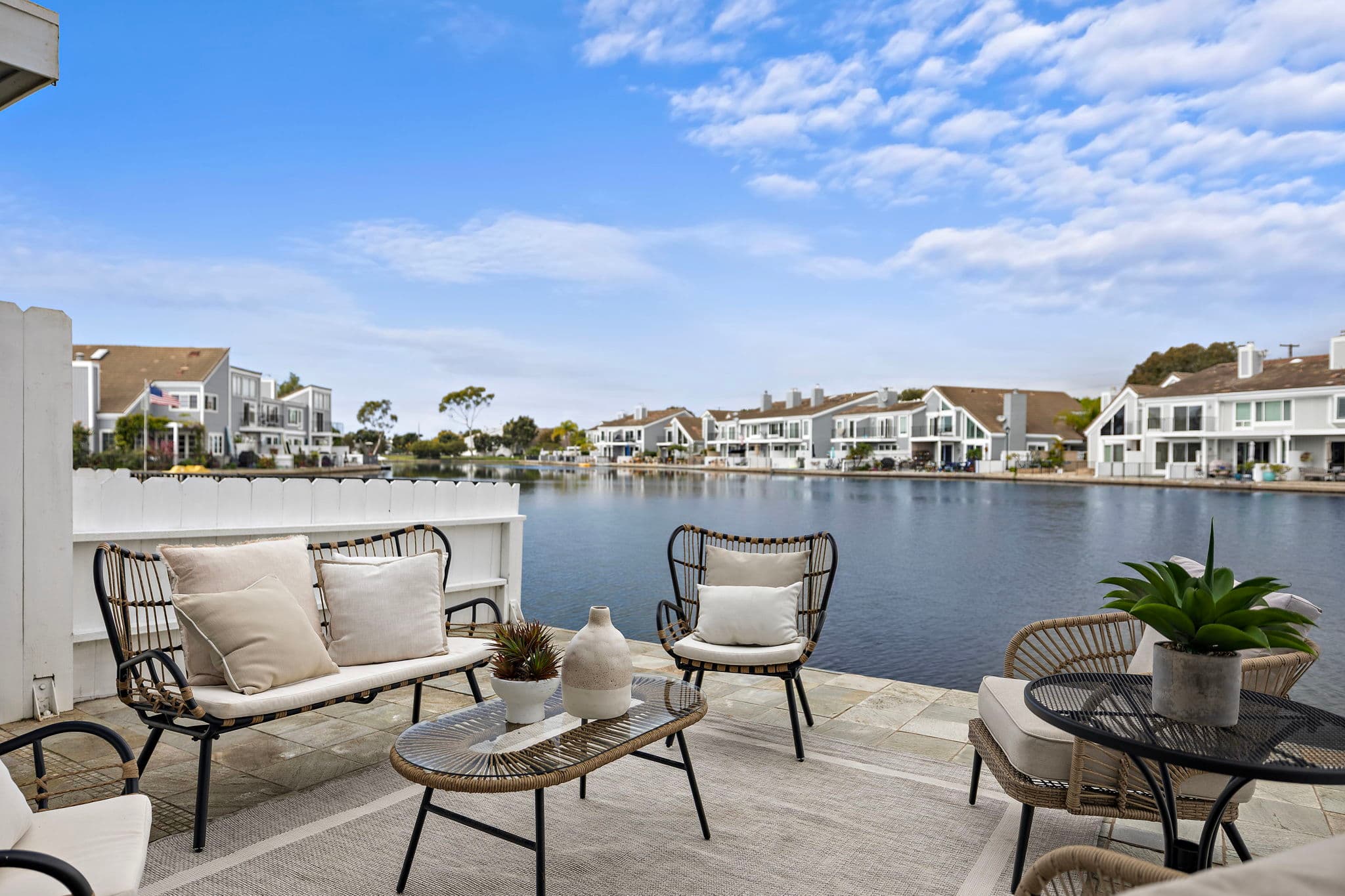
Buying a Huntington Harbour waterfront home: the dock diligence playbook.
The deep, practical playbook for buying on the water in Huntington Harbour, where the dock matters more than the floor plan.
Direct answer
Buying a Huntington Harbour dock home well comes down to the water, not the house. Price and resale are set by the dock permit, slip size, water depth at low tide, channel position, and seawall condition, and by which island the home sits on. Island lots and Mainland lots don't comp against each other, and a wide-channel big-boat slip is a different product than a narrow-channel one even when the houses match. Before you fall for the home, match the dock to the boat you actually intend to keep and pull the full waterfront diligence file. Ratowsky Group at Compass has worked the Harbour since 1977, and we're not appraisers, so any number here is a market opinion, not a valuation.
Updated 2026-06-24
At a glance
Five islands + Mainland
They don't comp alike
Trinidad, Davenport, Gilbert, Humboldt, Admiralty, plus the Mainland. Island and Mainland lots are separate products.
Bridge clearance
~23 feet
The harbour transit caps vessel height, so true big-boat lots are a small, premium subset.
The diligence file
Dock, slip, depth, seawall
Dock-permit status, slip dimensions, water depth at low tide, channel position, and a current seawall inspection.
What sets the comp
The water, not the floor plan
Two similar-looking homes can trade six figures apart based purely on where the dock points.
The whole idea
In the Harbour, you're buying the water first and the house second.
Most buyers walk a Huntington Harbour home the way they'd walk any home: kitchen, primary bedroom, light, layout. On the water, that's backwards. The single biggest driver of what you pay and what you'll eventually sell for is the dock and the channel it sits on, not the floor plan. Two homes that photograph almost identically can trade six figures apart because one has a wide-channel, big-boat-capable dock and the other backs onto a narrow, shallow finger. The house is the easy part to change. The water is fixed.
Huntington Harbour is the only true deep-water residential boating community on the Orange County coast: five man-made islands and a Mainland strip, threaded by channels where most island homes carry a private dock or a side tie. That scarcity is the whole value proposition, and it's also why the diligence is different here than anywhere else in town. This guide is the practical playbook. For the higher-level harbour-versus-oceanfront decision, start with our waterfront homes overview, then come back here once you know the harbour is your water.
Transcript and text alternatives
A verified transcript has not been published for this video. Request a transcript or call 714-336-5682 for the information in another format.
Geography matters
The five islands and the Mainland don't comp against each other.
The most common mistake out-of-area agents make is pricing the Harbour as if it were one neighborhood. It isn't. Trinidad, Davenport, Gilbert, Humboldt, and Admiralty each have their own street feel, lot patterns, and water characteristics, and the Mainland is a different animal entirely. Trinidad Island, where we sold 3801 Seascape Drive, sits among the most sought-after island addresses, with a mix of wide-channel and interior-finger lots. Each island carries its own blend of channel widths, orientations, and dock setups, so a comp from one rarely transfers cleanly to another.
Then there's the Mainland-versus-island split, which is the bigger divide. Mainland and non-waterfront homes near the water generally run about $1.5M to $3M and are the entry into the harbour lifestyle without a private dock. Island homes with a dock run roughly $2.5M to $5M and up. You cannot use one to value the other, full stop. We run every Harbour analysis by island first and water orientation second, because a south-facing dock on Trinidad is simply a different product than a north-facing slip on Humboldt, even when the two houses match on paper.
What changes from island to island
- Channel width and whether the lot fronts a main channel or a quiet finger
- Water depth at low tide, which decides what boats actually float there
- Dock orientation and how much sun and privacy the backyard gets
- Lot patterns and street feel, which shape the resale buyer pool
The file to pull
The waterfront diligence file, item by item.
Before you remove contingencies on a dock home, you want five things on the table. First, the dock-permit status: is there a current, clean, transferable permit, or are there open items the city or the harbour authority will want resolved? Second, the slip dimensions: actual usable length and beam, not the listing's rounded number. Third, water depth at low tide, because a slip that floats your boat at high tide and grounds it at low tide isn't the slip you think you bought. Fourth, channel position: main channel versus interior finger, and how wide it actually is. Fifth, the seawall.
The seawall deserves its own line because it's the quiet deal-killer. A current seawall inspection is among the cheapest things for a seller to handle up front and the most expensive for a buyer to inherit after closing. Cracking, settlement, or footing issues can run into serious money, and they don't show up in photos. We prepare this whole file, dock permit, slip dimensions, depth, channel notes, and seawall status, before the first walkthrough on our listings, and we pull it hard as a buyer's agent. We don't give legal opinions; that's for the title company and a coastal-property attorney. Our job is to make sure nothing on the water surprises you.
Before the emotion
Match the dock to your boat, not your boat to the dock.
The most expensive buyer mistake on the Harbour is falling for the house and then discovering the slip won't fit the boat. Slip length, beam clearance, and water depth at low tide all decide which vessels actually work, and the roughly 23-foot bridge clearance on the harbour transit puts a hard ceiling on height for anything that has to pass under it to reach open water. If you're shopping for a specific boat, or you already own one, that's the first measurement we take, before we get attached to a kitchen.
If the boat you want is bigger than the bridge clearance allows, the harbour isn't the wrong choice so much as the wrong harbor. Newport Harbor is the deeper, bridge-free alternative built for larger vessels, and we sell there too. For most Harbour buyers, though, the protected water, the walkable island streets, and a slip in the backyard are exactly the trade they're after, and a correctly matched dock is what makes the home work for a decade rather than for a season.
If you already own here
If you're selling on the water, the file is your leverage.
The same diligence that protects a buyer is leverage for a seller. The fastest way to lose money on a Harbour sale is to let the dock or seawall become a surprise in escrow, where it turns into a renegotiation on the buyer's terms. Handle it up front. A current seawall inspection and a clean, documented dock permit cost relatively little and let us market the home to the boater and move-up buyer pool that actually pays for the water, with nothing left to discover.
Pricing a Harbour home is its own discipline. Because island and Mainland lots don't comp, and because the dock drives the number, an automated estimate or an out-of-area agent's citywide read is close to useless here. We run every Harbour CMA by island first and water orientation second, then prepare a real net sheet so you see your actual proceeds, not just a list price. We're not appraisers, so the number is a market opinion of value; for a real read on your specific dock and channel, ask Craig and Justin for a current comparable-based review.
Frequently asked
Huntington Harbour waterfront, the questions we hear first.
What drives the price of a Huntington Harbour waterfront home?
Do the five islands in Huntington Harbour price differently?
What should I check on the dock before buying?
What size boat can I keep in Huntington Harbour?
Why don't island and Mainland homes comp against each other?
Why is my Zestimate wrong for my Huntington Harbour home?
How does Ratowsky Group sell a Huntington Harbour dock home?
Should I buy in Huntington Harbour or Newport Harbor?
Your Huntington Beach real estate team
Craig and Justin Ratowsky.
Craig Ratowsky and Justin Ratowsky are equal partners at Ratowsky Group, principal agents with Compass, and founding members of the Compass Huntington Beach office. Craig has sold Huntington Beach real estate since 1977, bringing 49 years of pricing and negotiation experience. Justin is a third-generation California Realtor® focused on local guidance and modern marketing. Together, they bring 58+ years of combined experience.
Sources & local citations
- City of Huntington Beach, Huntington Harbour
- California Coastal Commission
- Ratowsky Group sold stories
Qualitative claims framed as agent insight reflect Ratowsky Group’s direct experience and are not represented as third-party verified data.
Buying or selling on the water
Looking at a Huntington Harbour dock home?
Tell us the boat you have in mind, or the dock you already own, and we'll pull the real waterfront read: island, channel, slip, depth, and seawall, before you get attached to a floor plan. No pressure, just useful information.
Ratowsky Group at Compass. Craig Ratowsky DRE #00608046, Justin Ratowsky DRE #02026158. Guidance is general market context, not a valuation, tax, or legal advice.